
Subcontractor Management System for Construction & Trades
A subcontractor management system should control licenses, insurance, expirations, compliance holds, payout review, and the risks that spreadsheets usually hide until the project is already exposed, especially when no AI-assisted tracking is in place.
9 min read
This article is live. It is built to educate first, then move readers toward the audit checklist, the services page, and the next article in the sequence.
Why this article matters
Subcontractor-specific search traffic.
Author
AI Business Services Operations Team
Written by the AI Business Services Operations Team, focused on workflow automation, field reporting, compliance tracking, and admin cleanup for small businesses.
View author profile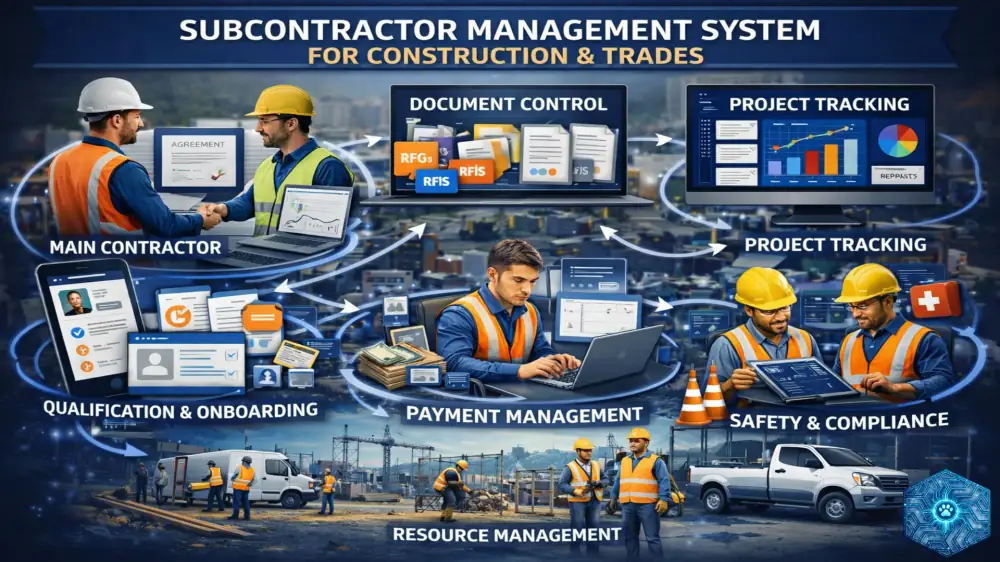
Introduction
Managing subcontractors well is one of the biggest pressure points in construction and trades. Between licenses, insurance, compliance, payout review, and field coordination, the details pile up quickly. When those details are managed through spreadsheets and manual follow-up, errors, delays, and hidden risk become much more likely.
A strong subcontractor management system gives construction companies a better way to control who can work, who can be paid, and what records are missing before a project problem turns into a financial one. When AI is layered into that workflow, it can monitor expirations, surface hold reasons, and support faster approval decisions with less admin drag.
Continue from here
Keep reading if you are still comparing options. Jump into the system if you already see the fit.
Key highlights
- A robust subcontractor management system helps construction companies streamline projects and reduce administrative drag.
- Project management software can track licenses, insurance, and compliance requirements in real time instead of relying on scattered spreadsheets.
- AI-backed expiration alerts and payment tracking reduce risk and improve payout accuracy.
- Centralized systems improve communication between project managers, field teams, and subcontractors.
- Dedicated construction software reduces errors and gives owners better control over job costs and risk exposure.
Why a Subcontractor Management System Matters in Construction
A subcontractor management system is not just a directory of vendors or trade partners. In a healthy construction workflow, it acts as a control layer that determines who is approved to work, who is payable, what documents are current, and where risk exists inside the job.
That matters because construction projects depend on outside teams moving through the workflow cleanly. If insurance expires, licenses go missing, or work gets paid without proper review, the business carries the consequences. The more projects and subcontractors you manage, the harder it becomes to control those details manually.
What a Subcontractor Management System Should Actually Control
The best systems go beyond a simple spreadsheet. They centralize the subcontractor profile, store compliance records, track document expiration, and connect the subcontractor record to reporting and payout review.
In practice, this means the system should answer four basic questions: who this subcontractor is, whether they are compliant, whether they are approved to work, and whether money should move.
- Profile and contact record.
- Insurance and license tracking.
- Document expiration monitoring.
- Payable versus on-hold status.
Essential Capabilities for Construction and Trades
A real subcontractor management system should support more than record storage. It should help project managers reduce admin work, surface compliance issues early, and make payout decisions with cleaner information.
The most useful systems are the ones that connect day-to-day field operations with approval and payout logic in the office.
Automated License and Insurance Tracking
Tracking licenses and insurance manually is one of the most repetitive and risky admin tasks in construction. Automated tracking removes that burden by storing the records in one place and monitoring their current status in real time.
This gives project managers a clearer view of which subcontractors are safe to keep active and which ones need follow-up before they create exposure on the project. When AI is involved, the system can also surface exceptions faster, summarize what is missing, and highlight which records are most urgent.
Expiration Alerts and Renewal Reminders
Integrated expiration alerts help prevent a subcontractor record from quietly becoming non-compliant in the middle of a project. Instead of discovering the issue after the fact, the system notifies the office and the subcontractor before the record expires.
That creates a more predictable workflow and keeps document issues from turning into schedule or payout problems.
Real-Time Payout and Payment Tracking
Payment tracking should sit close to the subcontractor record, not off to the side in a different tool. When work, compliance, and payout review are connected, it becomes much easier to verify what was done and whether payment should move.
This supports better payroll accuracy, reduces disputes, and helps owners protect margin instead of discovering financial issues after the money is already out.
Centralized Compliance Management
Construction compliance is not just insurance. It also includes safety records, contract obligations, approvals, and any internal requirements tied to the subcontractor relationship. A centralized compliance view keeps these requirements visible and easier to enforce.
- Standardized compliance processes across jobsites.
- Faster access to documents during audits or reviews.
- Better visibility into which subcontractors meet current requirements.
Collaborative Communication and Progress Monitoring
A strong subcontractor system also improves coordination. Project managers, field teams, and subcontractors need one place to share updates, monitor progress, and confirm what has actually been completed.
This reduces miscommunication and gives the office cleaner records to use for reporting and payout review.
Why Spreadsheet Tracking Breaks Down
Spreadsheets usually work only while the subcontractor count is low and the workflow is simple. Once more projects, trades, approvals, and document renewals are involved, the spreadsheet becomes a weak control tool.
The issue is not just organization. The bigger problem is that spreadsheets do not create live hold reasons, automated reminders, payout blocking logic, or a reliable audit trail. They record information, but they do not actively protect the workflow.
- No automated reminders for expirations.
- No live hold reasons tied to current compliance status.
- No direct tie between work reports and the subcontractor record.
- No payout blocking logic when a subcontractor should not be paid.
Key Features to Look For in a Subcontractor Management System
The best system is the one that fits the way your company actually works. For construction and trades, that usually means strong compliance tracking, practical field coordination, and clean integration with the broader workflow.
Advanced Tracking of Licenses, Insurance, and Certifications
The system should actively monitor credentials, not just store PDFs. Owners need a dashboard that makes compliance status visible and alerts the team before expired documents become a project risk.
Integration with Construction Workflow Management Tools
Subcontractor management should not stand alone. It works best when connected to reporting, scheduling, budgeting, and payout controls. That is why subcontractor tracking is most effective as part of broader workflow management.
Automated Compliance and Safety Reporting
Automated reporting creates a better audit trail and reduces the burden of keeping records current manually. It also helps owners standardize how compliance and safety information is collected across projects, while AI can help identify which missing items are most likely to block work or payout next.
Benefits of Using a System Over Manual Methods
Manual methods usually create hidden costs. Admin hours rise, payout mistakes become easier to make, and project managers spend too much time cleaning up documentation instead of moving the job forward.
A dedicated subcontractor management system creates one source of truth for records, approvals, and payouts. That improves efficiency, lowers risk, and gives the business a more defensible process.
Reduced Administrative Workload
Automation reduces the repeated tasks involved in document collection, reminder follow-up, and payout review. That gives the office more time to focus on decisions rather than document chasing.
- Less time spent on manual follow-up.
- Centralized records instead of scattered folders and spreadsheets.
- Cleaner task management for project teams.
Improved Accuracy and Lower Risk
A stronger system improves documentation quality and makes it easier to enforce approval rules consistently. That reduces the chance of paying the wrong subcontractor, missing an expiration, or losing track of the reason a subcontractor was put on hold.
It also gives project managers better information for evaluating subcontractor performance and deciding who should stay active across future work.
Conclusion
A subcontractor management system is one of the clearest ways to tighten construction operations without adding unnecessary complexity. By centralizing compliance, payout review, communication, and document control, it helps owners and project managers reduce risk while improving daily execution.
The biggest shift is moving from passive record-keeping to active workflow control. When the system can show who is approved, who is payable, and what is missing, the business makes better decisions before problems hit accounting or the jobsite.
For most contractors, the strongest next step is to start with the subcontractor spreadsheet or checklist they already use, then turn it into a live system tied to reporting, approvals, payout logic, and AI-supported alerts.
Download and next step
See how this spreadsheet becomes a fully automated system with approval rules and payout controls.
Frequently asked questions
Can small construction businesses benefit from subcontractor management systems?
Yes. Small construction businesses often benefit the most because they usually have less admin capacity to absorb paperwork mistakes, missing documents, and payout confusion. A subcontractor management system gives smaller teams better control without requiring a large back-office staff.
How does subcontractor management software improve communication and coordination?
It creates one central record for project information, status updates, compliance documents, and payout review. That gives project managers, field teams, and subcontractors a cleaner place to communicate and reduces the confusion that happens when information is split across texts, email threads, and spreadsheets.
What factors should I consider when choosing a subcontractor management system?
Look for fit first. The system should match your workflow, be usable by both office and field teams, and connect well with the other tools you already depend on. Strong compliance tracking, approval logic, and clean integration with broader workflow management matter more than a long list of generic features.
Next-step paths
Related next reads